BlueRail Trains is made up of three west coast developers with a background in high-tech and game development.
David Rees – CEO and Creative Director (background: 2d/3d art graphic design, music, sound, ui, game design and high-tech toys)
Pete Skeggs – Chief of Hardware (background: Senior embedded firmware engineer, electrical engineer, robotics, programming)
Eric Laun – Chief of Software (background: Senior UI and Game design programmer, robotics AI)

2010
I finally had a basement space capable of supporting a decent layout, and created a double-L comprised of 200 ft of 3-Rail Atlas O track. In my haste I made the grades too steep, leading into turns that were too sharp. After my nephews crashed a few O locos, I knew I would either need to re-do my layout, or move beyond standard transformer control. In 40+ years of model trains, I had always ran standard trains. For the first time I started researching my digital control options, and learned that my options were 2 competitive proprietary versions of DCC (DCS and TMCC). The more I read, the more I realized this was a decision I would be committing to. I began reading CV variable programming manuals to acquaint myself with general DCC basics. I also borrowed and examined the Cab controller interfaces and associated hardware (for my 2 options). This decision was going to require investment and commitment to learning. As a UI designer and user experience developer in games and high tech for 20+ years, I realized this technology pre-dated a lot of modern advancements from the last 15 years, and I knew my wife wasn’t going to be excited about the money I would spend.
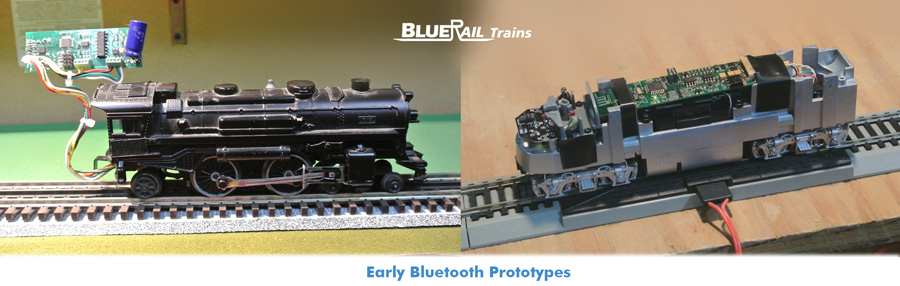
Around this same time, Bluetooth Smart was released, and I was fortunate enough to be doing app development for some of the first BLE smartphone controlled home lighting and backyard irrigation products. This new aspect of bluetooth supports unlimited simultaneous connections from hundreds of feet. I knew this was a great solution for my train control dilemma. I spoke with my former college roommate Pete Skeggs about making the board. He was president of the Portland robotics club, and had worked as senior embedded firmware engineer for EM Electronics and Intel. 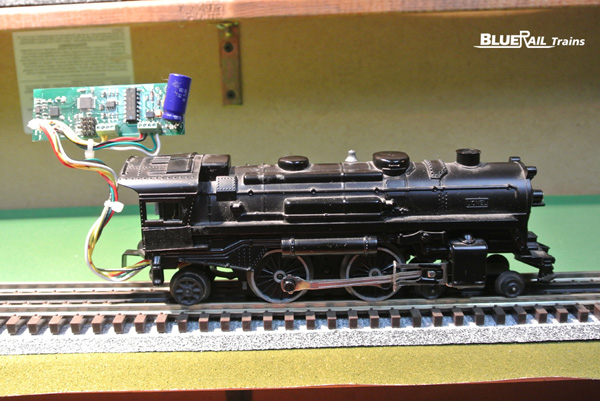 He is also the closest thing to Tony Stark this country will ever have. I also spoke with long time friend and work associate Eric Laun who is a senior UI and game design programmer with whom I had done game and tech development for many years. Pete created his own homemade bluetooth smart module and board while Eric and I developed the control app. I integrated the board into a basic Lionel steam loco within the tender. To our amazement the first board and app worked surprisingly well. We nicknamed the board “Boxcar Willy” (because it rode around in a trailing boxcar). Here is a picture of BCW v1:
With the success of BCWv1 we set out to create a smaller board that could fit in an HO F unit connected by a DCC-Ready cable. 6 months later BCW-V2 was completed – it had a smaller footprint and was outperforming it’s predecessor.
At this stage we realized what had started out as a personal basement tech experiment was revealing itself to be a great way to run trains – one that offers some distinct new advantages. BlueRail Trains was born.
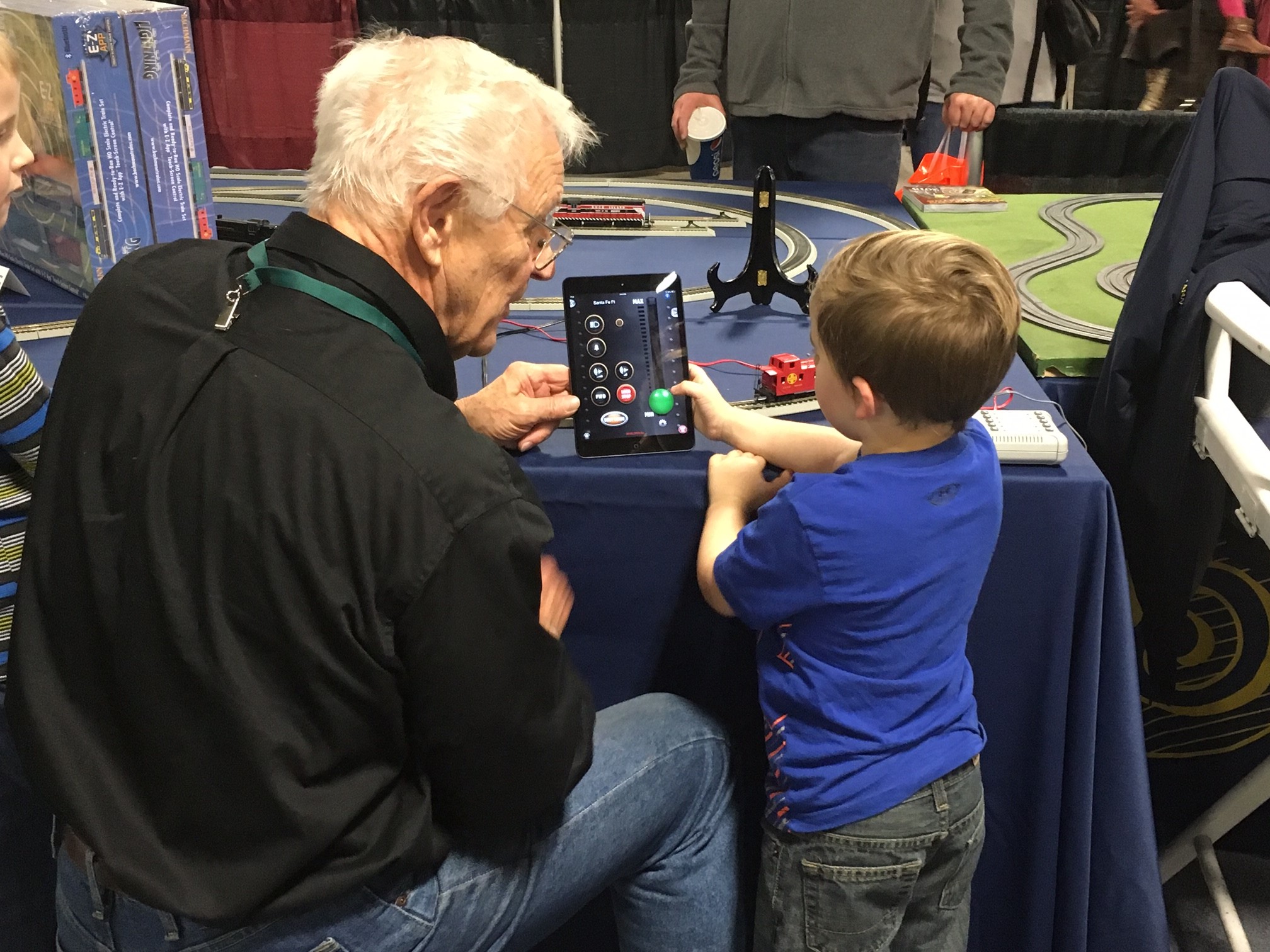
BlueRail has since partnered with Bachmann Trains and licensed this technology for use in Bachmann E-Z App™ train control. As Bachmann integrates bluetooth into their various lines, BlueRail is growing the application and feature set. BlueRail is also developing bluetooth plugin boards for use in any model train.
What’s so cool about bluetooth smart?
Bluetooth Smart has many great features that make it excellent for model train control.
Unlimited simultaneous connections – The Bluetooth Smart protocol has no defined limit on the number of simultaneous connections (trains) you can make. Perhaps we will find a limit someday, but for now it is safe to say you can use Bluetooth Smart to simultaneously run as many trains as you desire.
Great range – We have operated our BLE boards from 150 ft or more, and through up to 3 indoor walls. Of course no one really needs to run their train from 150 ft or several rooms away, but the fact that you can demonstrates efficient signal strength which means dependability and low latency. The technology works well with many users in close proximity without interference, and is a good solution for brass locos.
Updateable system requiring little hardware – The system depends on almost zero hardware; the control app is updateable software running on your smartphone, while everything in the loco is handled by firmware within a bluetooth module (which can be wirelessly updated at any time). This means the protocol and entire control system can grow through wireless updates without requiring new hardware. This frees users of the cost, update issues and obsolescence of older systems, while providing more intuitive user control without the big learning curve.
Bi-directional communication – All control is bi-directional, meaning the loco can talk back to the control app. This is a great advantage in things like consisting, cooperation between multiple trains, and allowing for realistic audio responses to how hard a loco is working.
Direct connection to a micro-computer (smart device) – With a direct connection between a train and any smartphone or touch device, control apps become possible on the most popular platforms in the world (iOS, Android, Windows, Mac etc) using the most standard modern protocol for connectivity. This also creates a platform for game and application development that works in conjunction with model trains (which we are excited to pursue).
Dead Rail support – Because our system doesn’t rely on track signals, BlueRail is an excellent choice for Dead Rail (battery powered trains). All BlueRail plugin boards have connection points for optional battery power.
Grows the hobby – BLE and touch screen control makes model trains accessible to a generation of new and younger tech-savy users and creates a platform for ongoing engaging content development.
Our Goal
Our goal at BlueRail is to use 25 years of user-interface, game and high-tech development to bring model trains to a new level of user experience that has equal appeal for new users as well as seasoned hobbyists. We are a few creative tech developers and friends who run trains, love high-tech, enjoy what we do and want to take it further.
If you use our free downloadable app to run a bluetooth loco (Bachmann E-Z App™ or BlueRail plugin boards) and notice any features you don’t like or think are missing, you can just wait for automatic updates as we add features, sounds and capabilities. The interface for great train control can be deceptively simple while maintaining robust underlying features.
If you are a smaller scale modeler concerned about the size of circuit boards, remember tinier bluetooth solutions come out every few months. It is only a matter of time before the technology miniaturizes to your favorite gauge.
If you are heavily invested in DCC and wonder how this fits into your world, remember we are hobbyists and understand the value of all the high quality locomotives and equipment out there (like fine Stratocasters). As interested as we are in creating a new modern train control system that is expandable and avoids obsolescence, we are also very interested in adapting BLE to work with existing equipment. We have no interest in supplanting DCC, and believe BLE is a protocol that has many applications that can advance all aspects of the hobby. Our focus is to create great interfaces, and it is our hope BLE will find a way to connect our interface with whatever protocol or loco you operate.
And if you hate new technology in every form and are angry about emerging technologies, remember that technology can bring a new generation of users to the hobby. New enthusiastic users allow the hobby to flourish and grow. Model railroading has been handed down from father to son for generations. We hope BlueRail can help that continue to happen.
Please use the video link above to see videos about various aspects of bluetooth train control.
David Rees
BlueRail Trains

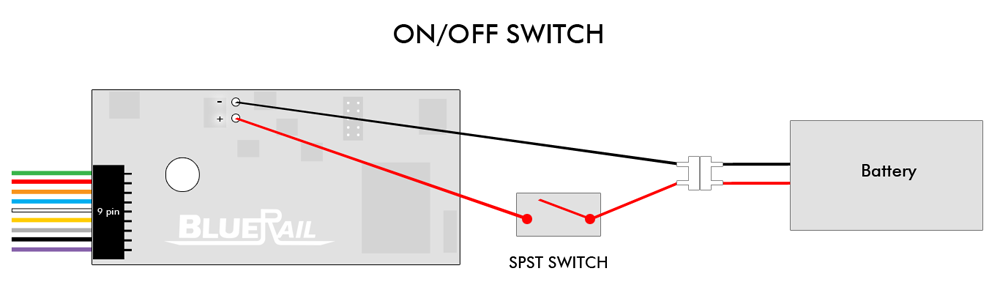
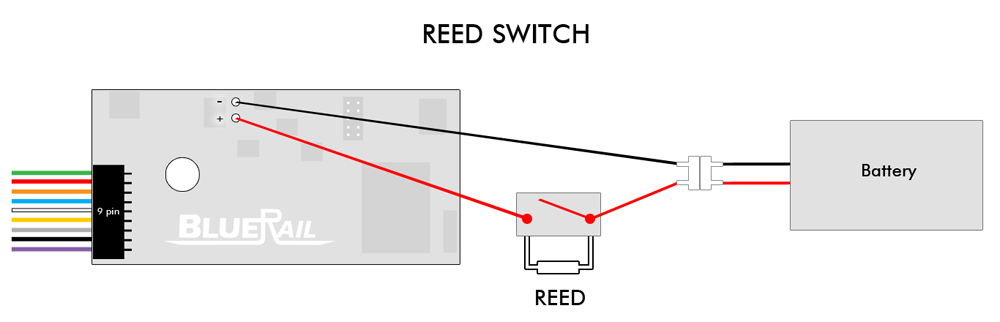
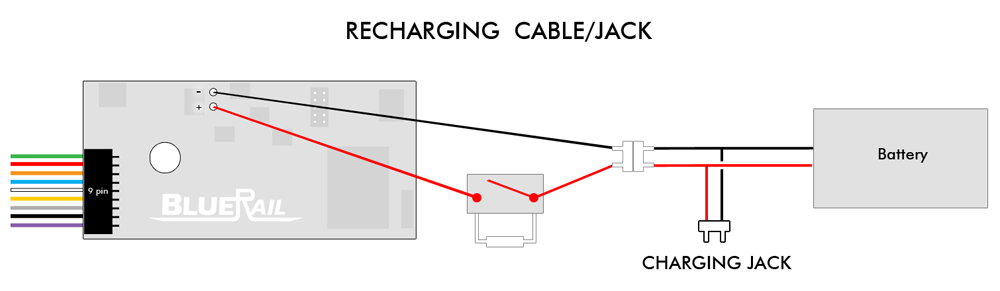
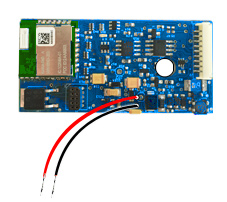 Because bluetooth does not rely on track for loco control, it is an excellent method for battery powered train operation (also known as “Dead Rail” or “Power On Board”). BlueRail plugin boards come with 2 connection points (+/-) which can be wired to a battery. Below are a few ways you may choose to wire your battery.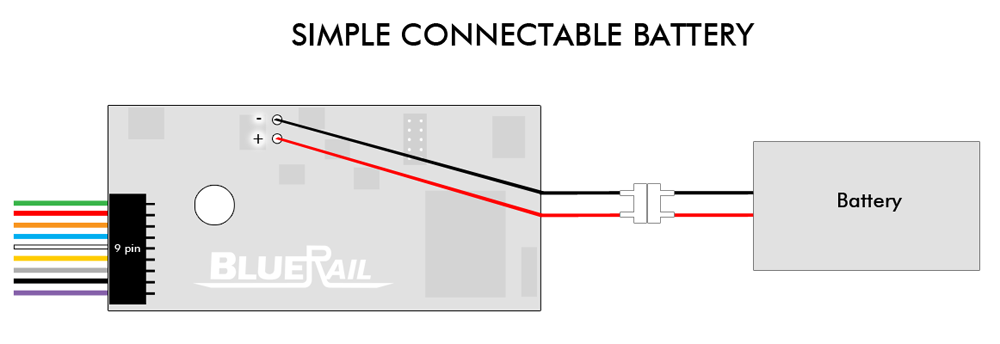

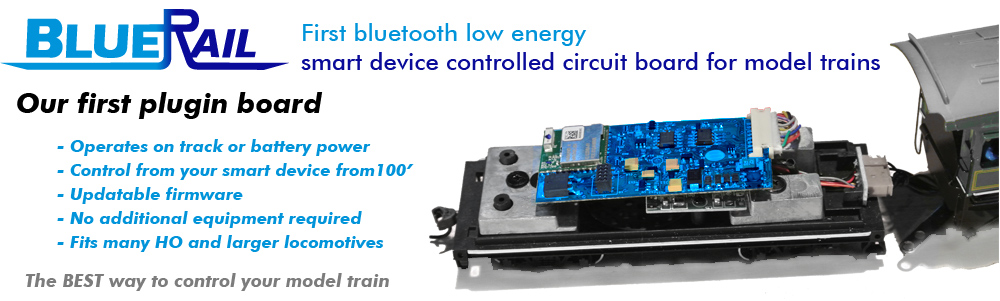
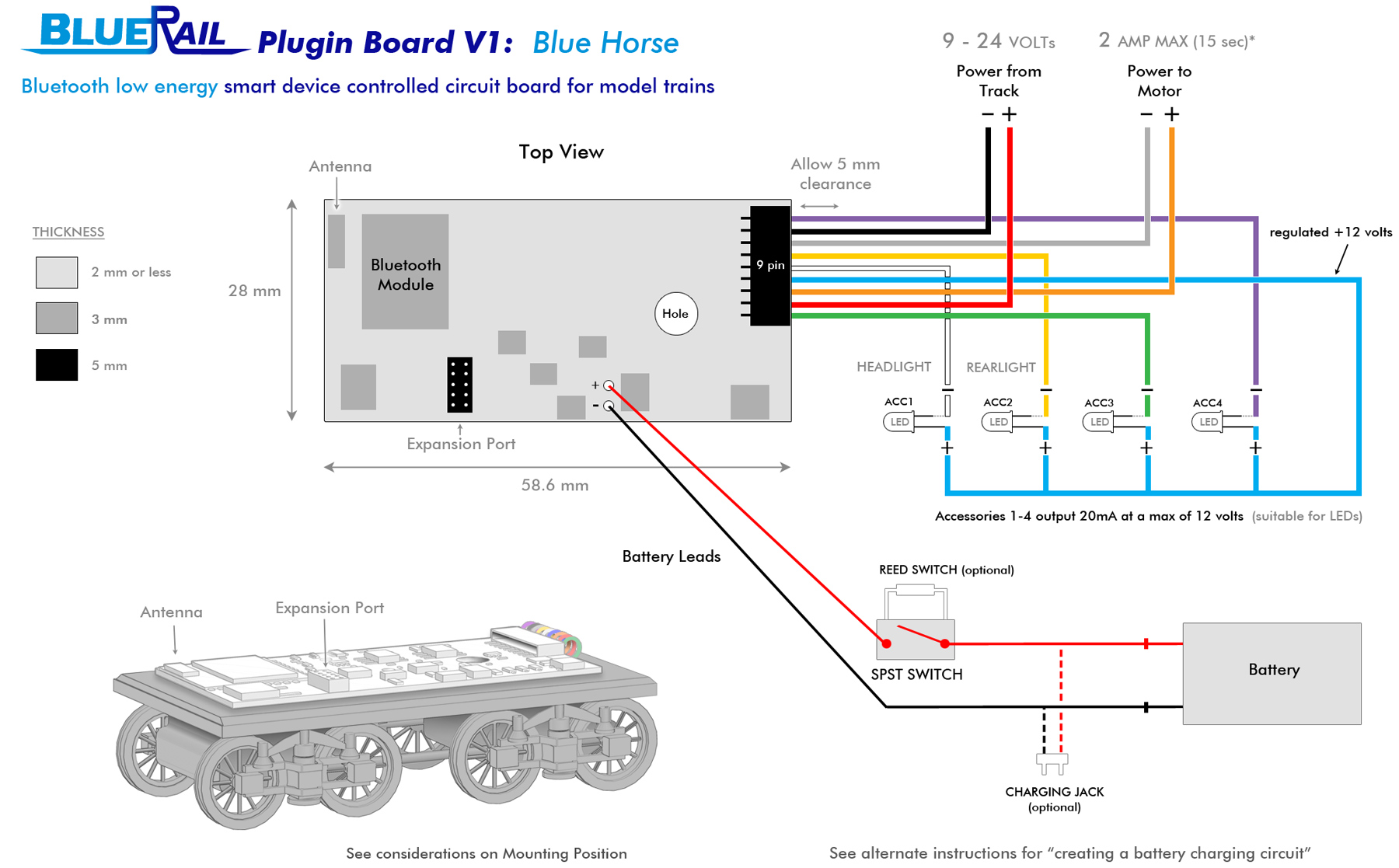
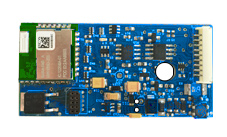 BlueRail’s first plugin board is now in manufacturing and we will begin taking orders in April. This first board has been nicknamed the Blue Horse. It measures 28mm x 58.6mm, features a 9-pin JST connection port, and can be used to drive any train with a DC can motor (not exceeding 2 amps*). Boards will be available on the BlueRail site for $75 plus tax and shipping within the US/Canada (see non-US and retailer sales info below). The boards can be easily plugged into any DCC-ready train, or wired directly to many non-DCC-ready locomotives. These boards are of particular interest to battery operated users (as they can run from either track or battery power). You will have control over speed, direction and up to 4 lights or accessories. The boards also contain an expansion port for future add-ons (sound). BlueRail boards may alternately be used to control up to 4 lights or accessories on your layout. Control your board using the configurable BlueRail app (see below regarding iOS/Android app) or the Bachmann E-Z App™. Please use the information below to decide if this first board is suitable for your needs. We will release subsequent boards in alternate dimensions and suitable for other gauges in the future.
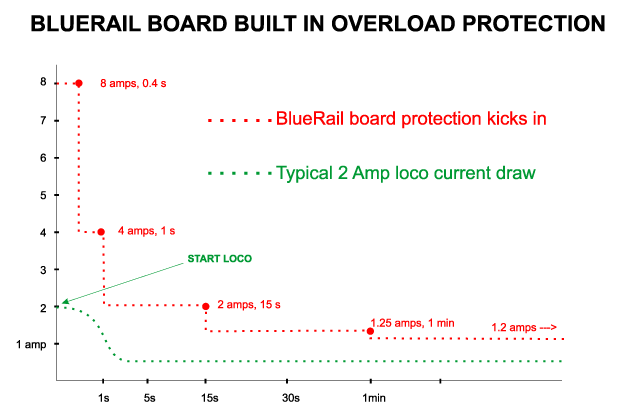 * Overload Protection: The BlueRail board contains circuitry to protect itself in the event of a current draw overload. Please refer to the graph to the left. The red line indicates the point at which the BlueRail board shuts itself off. The board will tolerate an 8 amp draw for .4 sec (before shutting itself off). It will tolerate a 4 amp draw for 1 second, a 2 amp draw for 15 sec (continuous), a 1.25 amp draw for 1 min (continuous) and a 1.2 amp draw continuously. A locomotive with a 2 amp stall current (green line) will typically draw 2 amps of current for the first few seconds it starts to roll, before stabilizing at a much lower current draw. Pulling heavy loads up steep long hills and lots of lighting will increase current draw. Please consider these values when deciding if this board is appropriate for your locomotive and layout.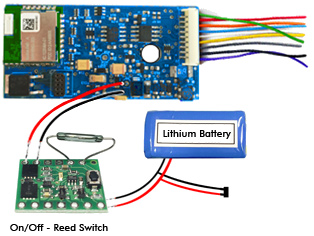
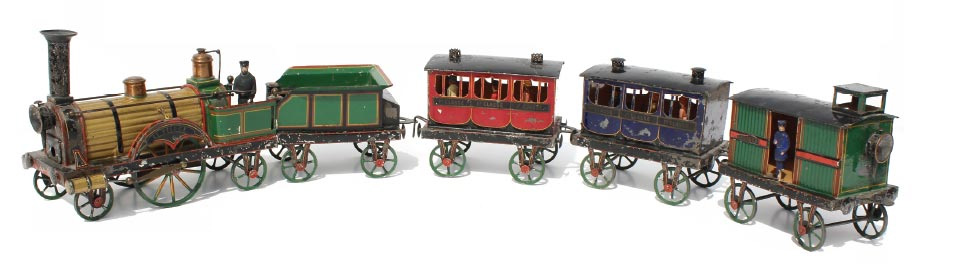
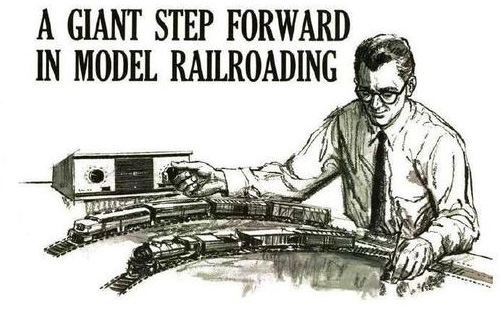 DCC requires electronic hardware (to send and receive signals) and is subject to issues related to dirty track. Shortly after the adoption of DCC, the late nineties brought large advances in personal computing, wireless connectivity and mobile devices. In the years that followed, model railroading benefited from the enhanced features of DCC, but the popularity of model railroading declined, and the hobby began searching for solutions to the limitations of DCC. In 2011 bluetooth low energy (BLE or Bluetooth Smart) was added to the bluetooth protocol as part of bluetooth4. Because BLE allows for connection to many devices simultaneously at great range with low packet loss, it is an excellent solution for model train control. In 2012 a small group of high-tech and mobile application/game developers in California saw this solution and designed a circuit board and application for train control and formed BlueRail Trains. Their background in high-tech toys, robotics, game/app and early BLE development made BlueRail well-suited to take on the challenge. (See photos of early prototypes below).